Benchmark experiments for validating seismic models
Nonlinear building models are calibrated on isolated component tests, then trusted to predict how a complete structure behaves in an earthquake. System-level experiments are expensive and time consuming. We suggest a methodology for solving this problem.
I combine geotechnical centrifuge shake table testing with 3D printing, which makes it feasible to build and test many nominally identical small-scale structures instead of one expensive specimen. The result is a dataset with enough repetitions to support probabilistic validation: not "does the model match this test," but "how much of the scatter in the real structures does the model reproduce?" The unreinforced masonry dataset from this work is openly available, and formed the basis of a blind prediction contest organized with the Pacific Earthquake Engineering Research Center (PEER) at UC Berkeley, where independent teams predicted the response before the results were released.
Interested? Then read our papers:
[J1] benchmark dataset in Earthquake Spectra ·
[C1], [C4] centrifuge modelling of URM ·
blind prediction contest results in preparation.
Data: link to the dataset repository.
Funding:
European Research Council; Swiss National Science Foundation
Additive manufacturing for small-scale reinforced concrete
We apply the same methodology to Reinforced Concrete. Reduced-scale reinforced concrete has always been limited by the reinforcement. At centrifuge scale you cannot bend and tie a realistic cage, so models end up with reinforcement that is the wrong geometry, the wrong strength, or bonded the wrong way.
We developed additively manufactured steel reinforcement paired with a matched micro-concrete, and characterized it the way any new structural material has to be characterized: tensile response first, then bond, then component behavior. Printed cages were used to build columns and beam-column joints that were tested under cyclic loading and compared against their full-scale counterparts. The outcome is a repeatable production route for small-scale RC specimens, which is what makes statistically meaningful testing programs possible in the first place.
Interested? Then read our papers:
[J6] tensile and bond behavior ·
[J4] columns ·
[J5] beam-column joints ·
Funding:
ETH Zurich
Seismic topology optimization and AM/robotic prototyping
Current work at MIT. Topology optimization can optimize the amount of material we use in our structures. For reinforced concrete, this means less carbon emission. Concrete behaves very differently in tension and compression, and seismic demand is dynamic and nonlinear rather than a static load case. I aim to build algorithms that model this complex behavior.
Fabrication and testing is major gap in Topology Optimization. We aim to prototype and test Optimized layouts. We physically fabricate designs using additive manufacturing and robotic fabrication, so the designs are checked against what can actually be built rather than only against a theoretical objective function.
Status: Journal paper in preparation.
Funding:
Swiss National Science Foundation (CHF 186,666, 2026–2028);
Affordable earthquake-resistant construction
Most of the world's seismic risk sits in buildings of low-income and developing countries. Techniques that assume a design office, a testing lab, and an industrial supply chain do not reach them.
I work on structural systems that stay within the means of low-income regions. One line is corbel dwellings assembled from interlocking compressed earth blocks: blocks that lock together without mortar and can be produced on site from local soil. I characterized their shear behavior and tested complete dwellings on a centrifuge shake table. A second line is low-cost seismic isolation, combining rolling-ball bearings with sand-sandwich layers, tested both in the centrifuge and on a three-directional shake table. The direction I am most interested in is designing the two together, so the isolation system and the superstructure are conceived as one system rather than an expensive technology adapted downward.
Interested? Then read our papers: [J2] shear behavior and centrifuge modeling of corbel dwellings · rolling isolation studies in preparation (P2, P3).
Modeling uncertainty and how it propagates
The seismic analysis of structural systems is fraught with uncertainties, both aleatory and epistemic. Aleatory uncertainties are intrinsic to the unpredictable nature of seismic events and remain immutable. Conversely, epistemic uncertainties stem from incomplete knowledge, such as uncertain model parameters or modeling methods. Modeling method uncertainty can manifest as bias,a systematic deviation from true performance values and/or as variance, adding noise to the seismic response. Thus, considering both model parameter (intra-model) and model type (inter-model) sources of uncertainty is key.
I aim to address that through test-informed nonlinear probabilistic models. This means test database should created and complemented with new experiments. Then, uncertaies can be reduced and/or quantified.
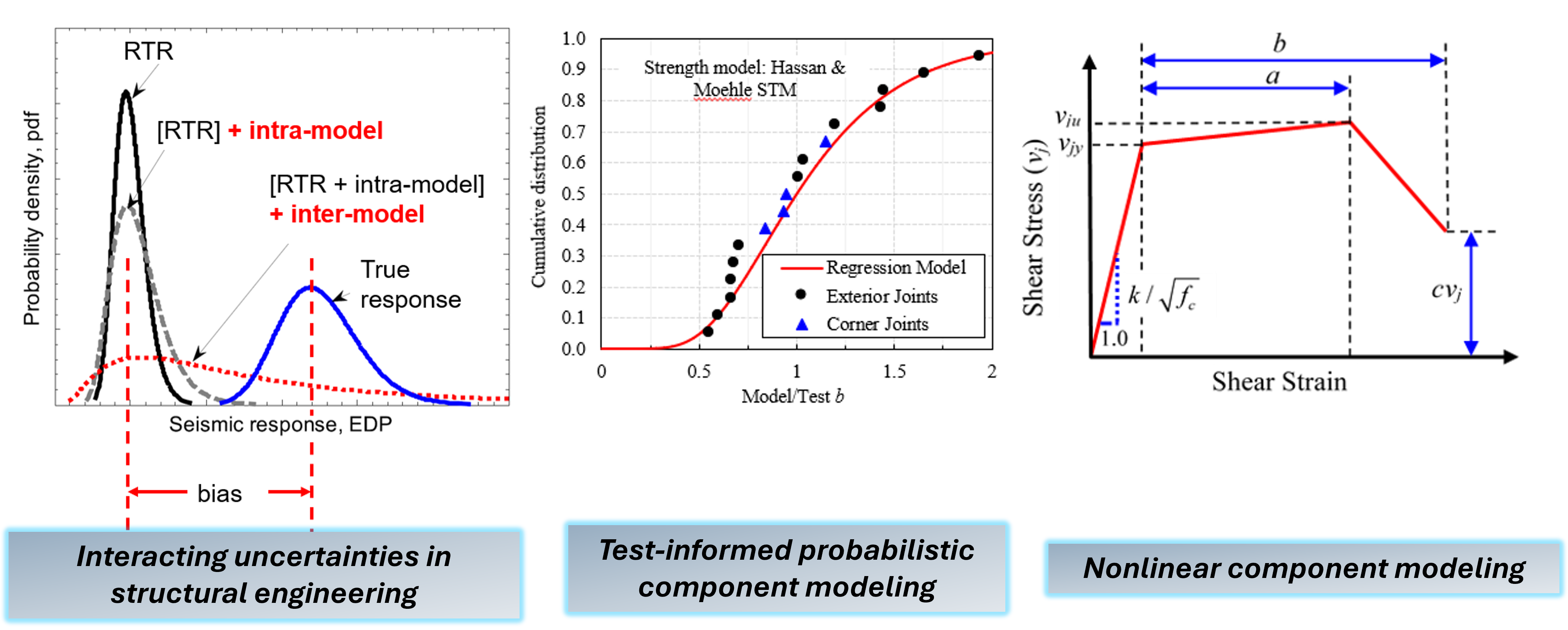
Papers: [J3] propagation to frame response · [J8], [J9] joint models · [J10], [J11] database reviews.
Collaborators
This work is done with experimentalists, materials scientists, and computational groups across several institutions.
- Josephine Carstensen — Civil and Environmental Engineering, MIT. Topology optimization for seismic design.
- Michalis Vassiliou — School of Civil Engineering, NTUA (formerly ETH Zurich). Physical modeling, rocking and isolated structures.
- Ioannis Anastasopoulos — ETH Zurich. Centrifuge shake table testing.
- Dimitrios Vamvatsikos — School of Civil Engineering, NTUA. Performance-based assessment and uncertainty propagation.
- Christian Leinenbach — Empa. Additive manufacturing of steel reinforcement.
- Kristina Shea — ETH Zurich. Computational design and fabrication of interlocking block systems.
- Khalid Mosalam and Selim Günay — PEER, UC Berkeley. Blind prediction contest on URM model validation.
- Wael M. Hassan — University of Alaska Anchorage. Probabilistic beam-column joint modeling.